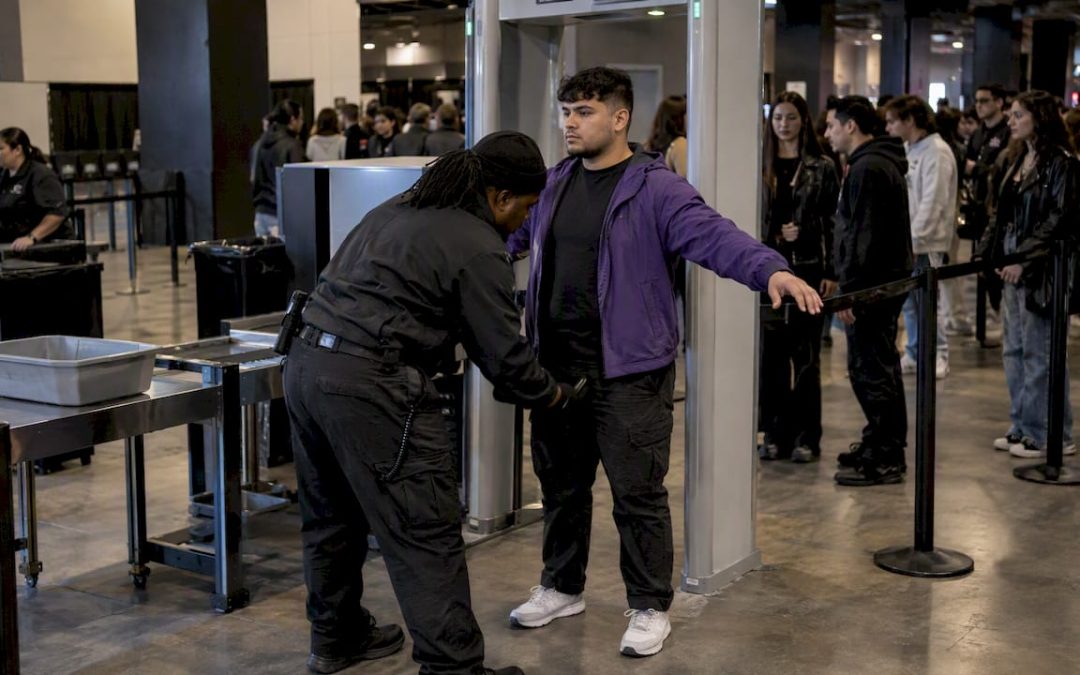
A concert security check is usually three steps: a ticket scan, a bag search, and a screen with a walk-through metal detector, a handheld wand or a pat-down. It takes a few minutes if you arrive prepared and a lot longer if you show up with a big bag, a banned item or a dead phone. Here is how it works, what gets confiscated, and how to move through the line like you’ve done it a hundred times.
TL;DR
- Expect a ticket scan, a bag check and a metal detector, wand or pat-down. Rules differ by venue, so read the event page before you leave home.
- Leave weapons, outside drinks, glass, cans, large bags, pro cameras, selfie sticks and laser pointers behind. Many venues have nowhere to store them.
- Show up early, carry only essentials, and have your ticket and ID ready on a charged phone.
- Screening is supposed to be consistent and courteous. Stay calm, follow the instructions, and ask a supervisor if something seems off.
- If you’re stuck on what to wear or pack, our guides below cover bags, food, cameras and outfits.
Table of Contents
- What actually happens at a concert security check
- Metal detectors at concerts: walk-through, wand or pat-down?
- What you can’t bring: the usual banned list
- Do concerts check ID?
- How to get through faster: a pre-show checklist
- Going to an outdoor festival? Screening gets bigger
- Our perspective: security and a good party aren’t opposites
- Planning a show of your own? The organizer’s side
- Make the next night out an easy one
- FAQ
- Sources
What actually happens at a concert security check
The exact routine depends on the venue and the show, but the pattern is familiar. Federal guidance from CISA’s Public Venue Security Screening Guide (August 2026) lists walk-through metal detectors, handheld metal detectors, X-ray machines and additional screening as possible methods. The same guide says screening policies should name prohibited items in advance and apply to everyone entering, including staff, vendors, performers and media, not just ticket holders.
In practice, you’ll move through something like this:
- Line up and get your things ready. Bags open, pockets emptied of keys, coins and anything bulky, phone out with your ticket on screen.
- Bag check. A screener looks through your bag or purse. Bag-size limits exist partly to keep this step quick. Reporting from CU Independent notes that limits on small or clear bags speed up lines and make inspections more thorough.
- Body screen. You walk through a magnetometer, or a screener passes a wand over you. At some venues it’s a pat-down instead.
- Secondary screening. If something alarms, you’ll be asked to step aside and a screener will check again. A belt buckle, a chain or a set of keys is usually the culprit.
- Ticket scan and entry. Some venues scan first, some last.
The vast majority of people clear this without any issue. The people who hold up the line are the ones who didn’t read the rules.
Metal detectors at concerts: walk-through, wand or pat-down?
You’ll see all three, sometimes at the same gate.
| Method | What it looks like | What sets it off | How to speed it up |
|---|---|---|---|
| Walk-through detector | Airport-style frame you step through | Keys, coins, belts, heavy jewelry, metal on shoes | Empty your pockets into your bag before the line |
| Handheld wand | Screener waves it near your body | Same metals, plus phones and wallets close to the body | Stand still, arms out, and follow the screener’s directions |
| Pat-down | Hands-on check of outer clothing | Used as a primary method at some venues or as follow-up to an alarm | Wear fewer layers and skip bulky gear |
CISA’s guidance frames screening as a respectful, consistent process, with screeners expected to greet people, make eye contact, stay courteous and use care around sensitive areas of the body. If a pat-down makes you uncomfortable or you have a medical device, say so politely before screening starts and ask for a supervisor if you need an alternative. Venues commonly have a process for guests with medical needs. For more on that, see our guide to ADA concert tickets and access.
One thing to know: some venues screen everyone, no exceptions. The Grand Ole Opry, for example, says everyone entering is screened, children included. Don’t assume a kid or a VIP wristband gets you around the line.
What you can’t bring: the usual banned list
Every venue publishes its own list, and that list beats any general checklist, including this one. That said, the same items show up again and again:
- Weapons, knives and firearms
- Illegal drugs
- Outside alcohol and food
- Glass bottles and cans
- Oversized or non-compliant bags
- Laser pointers
- Professional cameras and recording gear
- Selfie sticks and drones
- Umbrellas and anything that could disrupt the crowd
Bag size is where most people get caught. Mesa Amphitheatre, for example, publishes a 12 x 6 x 12 inch clear-bag limit. Other arenas set a 12 x 12 x 6 inch cap. At PPG Paints Arena in Pittsburgh, a third-party venue guide from 2025 says clutches must be smaller than 4.5 x 6.5 inches and clear bags can’t exceed 12 x 6 x 12 inches, with no on-site bag check. Policies change, so confirm on the venue’s own site before the show.
That last point matters. Many venues have no place to hold what you can’t bring in, and if you’re turned around at the gate, your options are your car or the trash can. If you want a deeper breakdown, we wrote up how the clear bag policy works and how fans beat gate lines, plus guides on concert camera rules and bringing food to a show.
Do concerts check ID?
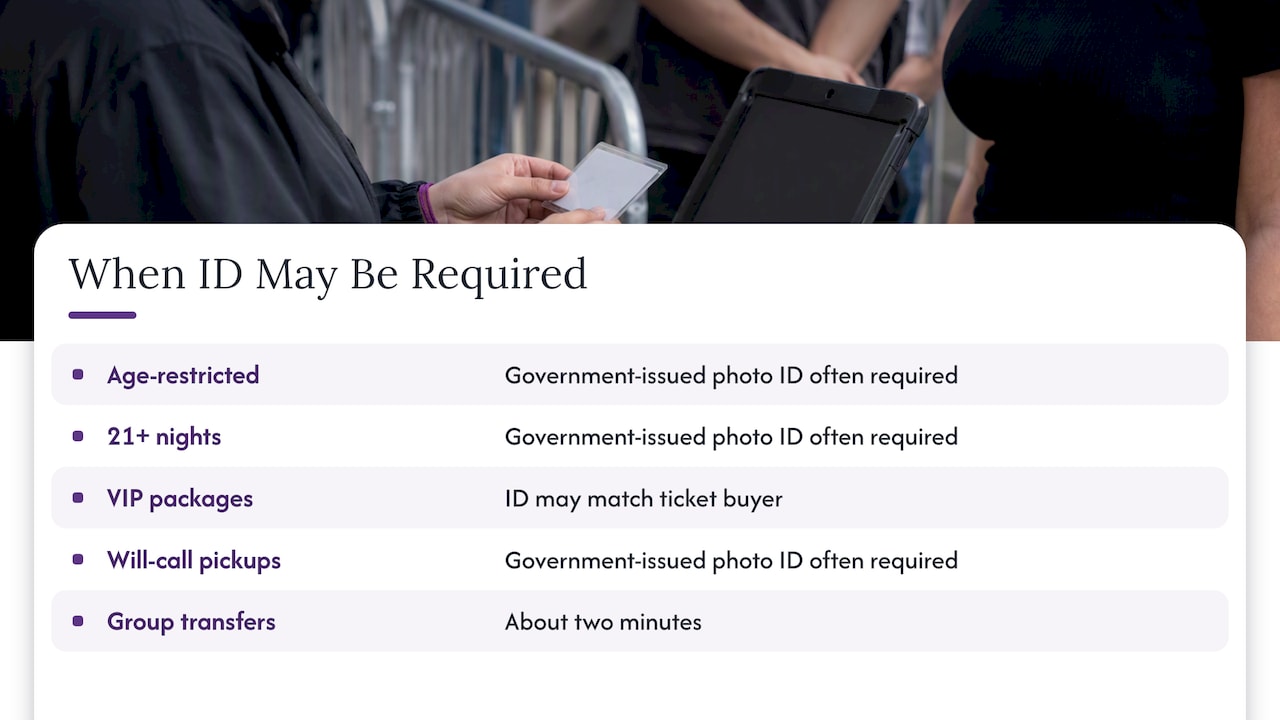
They can, and for some shows they will. Age-restricted events, 21+ nights, VIP packages tied to the ticket buyer and will-call pickups often require a government-issued photo ID. The ticket page or confirmation email says whether yours does. If it says ID is required and you don’t have it, you may not get in, and refunds aren’t guaranteed. We cover this in detail in why forgetting ID can mean no entry or no refund.
Beyond ID, think about how your ticket gets to the gate. If you’re going with a group and one person bought everything, sort out transfers before you leave. Our walkthrough on mobile ticket transfers for groups shows how to do it in about two minutes, so nobody is standing at the gate refreshing an email.
How to get through faster: a pre-show checklist
The smoothest entry is almost always set up before you arrive. Here’s what works.
The night before
- Read the event page for the prohibited items and bag policy. Screenshot it in case cell service is bad at the venue.
- Charge your phone fully. A dead phone can mean a dead ticket.
- Decide what you’re carrying. If it doesn’t fit in your pockets or a small clutch, ask whether you really need it.
- Plan your outfit around the screening: fewer metal accessories, nothing bulky. Our list of indoor concert outfits that survive a packed show helps.
Before you leave the car
- Leave banned items in the vehicle or at home, not in your jacket.
- Empty your pockets into your bag or a clear pouch so you can walk through without a stop.
- Take out your ID and open your ticket.
If you’re driving, think about the exit as well as the entrance. Parking that puts egress first can be the difference between a five-minute walk and a 45-minute crawl after the last song.
In the line
- Arrive early. Opry-style notices and other venue rules commonly tell guests to allow extra entry time, and secondary screening adds minutes if you alarm.
- Keep the group together and ready. One person fumbling holds everyone.
- Be polite. Screeners are doing a repetitive job, often for a long shift, and a friendly tone gets you through faster than an argument.
Going to an outdoor festival? Screening gets bigger
Festivals add fencing, multiple entry gates and sometimes re-entry rules. Expect the same checks, with more distance to walk, sun and heat, and often a cashless payment setup inside. If you’re planning your season, this roundup of Southern California festivals is a handy example of how much logistics goes into a festival weekend, from tickets to transport. And if cards or phones are your only way to pay inside, see our 12 week plan for cashless events for what that means at the gate and at the bar.
Looking for outdoor shows to plan around? We keep a running guide to outdoor hip hop festivals across the U.S..
Our perspective: security and a good party aren’t opposites
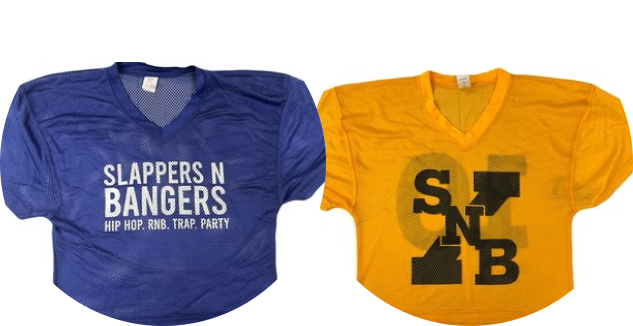
We’ve been throwing hip hop, R&B and trap parties in Pittsburgh since 2015, and we started SNB because too many local venues were hesitant about the music we love. That history shapes how we think about the front door.
A good security check does two jobs. It keeps the room safe, and it sets the tone before anybody hears a beat. If the line is chaotic, rude or confusing, the party starts in a bad mood. If it’s clear, quick and respectful, people walk in ready to dance. That lines up with the CISA guidance: firm rules, applied the same way to everyone, delivered with courtesy.
Our advice from the organizer side is simple:
- Read the rules for the specific event. Every venue and every show is different, and our events are no exception.
- Travel light. The less you carry, the easier the night. Your phone, ID, a card and keys cover most of it.
- Treat the door crew as part of the night. They’re the first people you meet at the party, and a little patience makes the whole room better.
- Come with your people and arrive on time. A packed dance floor is built from a lot of people getting in smoothly.
Hip hop crowds have long been judged unfairly by venues that didn’t want us. Showing up prepared and respectful is how we keep proving those venues wrong.
— Slappersnbangers@gmail.com
Planning a show of your own? The organizer’s side
If you’re running an event rather than attending one, screening is more than a detector at the gate. CISA’s guide identifies written policies, trained screeners and supervisors, communications equipment, containers for removed items, flashlights, protective equipment and tested detectors as parts of a complete program.
Broader safety planning covers more ground. A written plan typically addresses site layout, entrances and exits, crowd flow, staffing, incident command, medical response, evacuation, traffic, accessibility, alcohol management and coordination with police, fire and EMS. California’s Concert and Festival Crowd Safety Act materials are one example of what an event operations plan can be required to include, though that is California law and your state’s rules will differ. Check with your local authorities before you sell a single ticket.
Make the next night out an easy one
If you want a party where the music is played the way it was meant to be, with DJs who read the room and a floor full of people who came for the same thing, take a look at what’s coming up. Our SNB events page has the latest, including August SNB: 400 Degreez, and the home page has our 11th Anniversary and new and limited edition merch. Check each event listing for its entry rules before you go. Going solo? Our tips for meeting people at concerts will help.
FAQ
Do concerts check ID?
Some do, many don’t. Age-restricted shows, 21+ areas, VIP packages and will-call pickups commonly require a government-issued photo ID. Check your ticket confirmation, and bring ID anyway if you’re unsure.
Will there be metal detectors at a concert?
At large venues, very likely. You may walk through a detector, get scanned with a wand or get a pat-down, and some venues use more than one method. Smaller clubs may only do a bag check and ID check, so look at the venue’s policy page.
What happens if I bring a prohibited item?
You’ll usually be asked to take it back to your car or throw it away, and some venues don’t offer any holding service. Weapons or illegal drugs can lead to being denied entry or to a call to law enforcement. Leave anything questionable at home.
How early should I get to a concert to clear security?
Venues commonly advise allowing extra time, and big shows with headliners can mean long lines right at doors. Arriving shortly after doors open usually beats showing up right before the first act. If you need medical or accessibility accommodations, give yourself even more room.
Sources
- CISA Public Venue Security Screening Guide (August 2026)
- Mesa Amphitheatre Rules & Policies
- CU Independent: How Safety and Security Checks are Handled at Concerts
- PPG Paints Arena Bag Policy guide
- California Concert and Festival Crowd Safety Act (AB 2681)