GA wins on energy, price, and the shared chaos of the crowd. VIP wins on comfort, time saved, and predictability. The rule of thumb: only pay for VIP when its perks replace costs you’d already have (parking, food, a hotel-quality restroom line) or when the event is long, hot, or multi-day enough that comfort actually changes your night.
TL;DR:
- VIP perks like early entry, re-entry, and dedicated lounges can save time and improve comfort during long, hot multi-day festivals but may have limited value at short shows.
- The actual cost-benefit of VIP depends on direct savings from included amenities and avoided expenses, often making VIP worth it only when these benefits exceed the additional ticket price.
- Group upgrades typically provide the best experience, ensuring everyone shares perks and avoids splitting into separate crowd zones, especially at multi-day or outdoor events.
- GA tickets can often offer better value at small, single-set venues where sightlines are adequate and crowd energy outweighs the need for comfort.
- Always verify what each ticket tier explicitly includes, as the meaning of VIP varies by event, and tier descriptions matter more than marketing labels.
Table of Contents
- GA vs VIP: What Changes on the Ground
- Is VIP Worth the Extra Cost? Here’s the Math
- When Is VIP Worth the Upgrade?
- How to Buy and Use GA or VIP Tickets the Right Way
- How Slappers N Bangers Thinks About Ticket Tiers
- What Do GA and VIP Actually Mean?
- Where GA and VIP Tiers Came From
- The Biggest Myths About GA and VIP
- Which Events Actually Reward the Upgrade?
- Refunds, Transfers, and Resale Rules by Tier
- COVID-Era Changes That Stuck Around
- When We’d Splurge on VIP (and When We Wouldn’t)
- Check Ticket Tiers for Upcoming Events
- Sources
- FAQ
GA vs VIP: What Changes on the Ground
The difference between GA and VIP shows up in four places: how you get in, where you stand, who’s around you, and what’s available when you need a break. Everything else is marketing.
Access. VIP tickets usually come with a dedicated entrance and an early-entry window, which matters more than people expect. Skipping a 45-minute GA line to grab a spot near the rail before doors even officially open is the single perk that most consistently earns its price. Some VIP tiers also allow re-entry, which GA rarely permits once you’re through security.
Viewing. This is where claims get slippery. A “reserved VIP viewing area” might mean a raised platform with a clean sightline, or it might mean a roped-off patch of grass that’s technically closer but still standing-room. Ticketmaster defines GA as unreserved seating or standing occupied first-come, first-served, meaning your GA spot depends entirely on how early you show up and how hard you’re willing to hold your ground.
Amenities. This is VIP’s real strength. Dedicated bars with shorter lines, air-conditioned lounges, and restroom trailers that don’t smell like a bus station by hour three. Some tiers bundle food or drink credits and merchandise, which can meaningfully offset the ticket premium if you’d have bought that stuff anyway.
Crowd and atmosphere. GA has the energy. Packed, loud, unpredictable, and honestly part of the appeal for a lot of shows. VIP sections tend to be calmer and more spread out. That’s a plus if you want to actually hear conversation between sets, but it’s a real cost if your friend group splits up because only half of you upgraded.
- Dedicated entrance and early entry save time before doors open
- “Reserved viewing” varies wildly by promoter, so read the specific description
- Lounges and separate restrooms are VIP’s most consistently delivered perk
- Splitting your group between tiers can hurt the night more than the upgrade helps
Is VIP Worth the Extra Cost? Here’s the Math
Sticker price alone tells you almost nothing. The real question is what the upgrade actually costs once fees are added, and what it replaces that you would have paid for anyway.
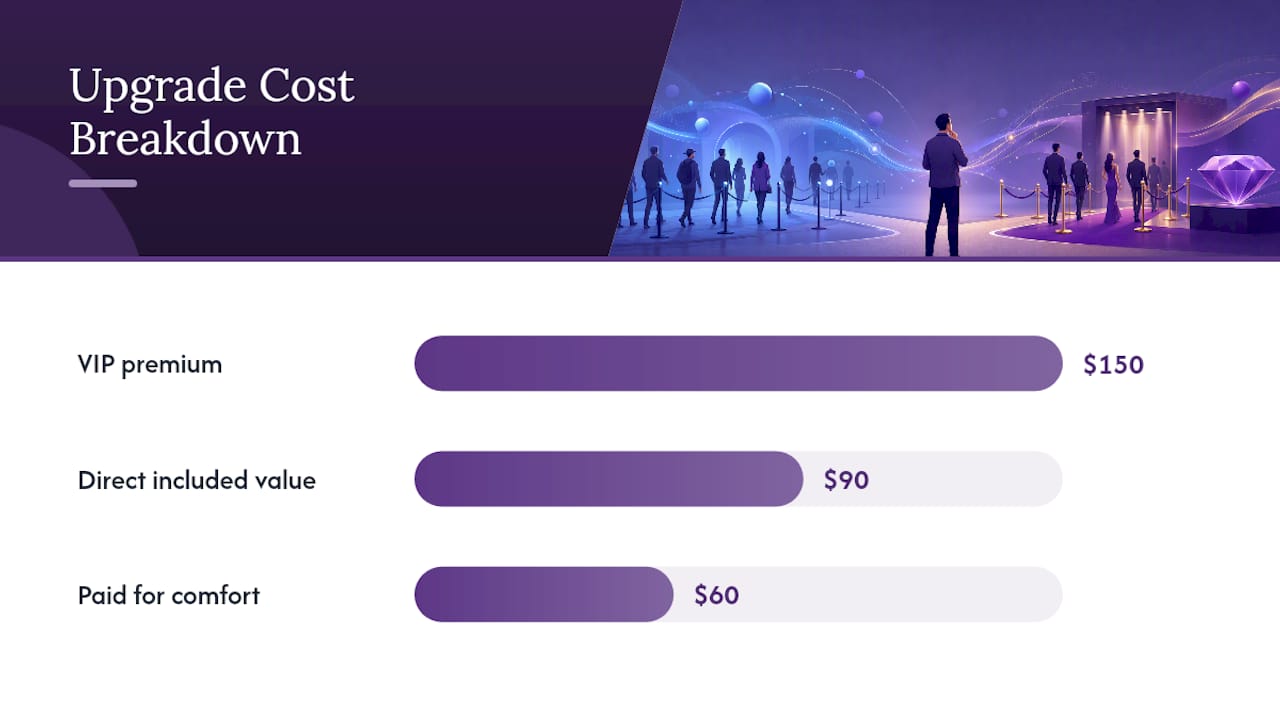
Start with your out-the-door upgrade cost: the ticket price difference, plus service fees (which often scale with price, so a bigger upgrade means bigger fees), plus anything you’d add on regardless, like parking or a meal.
Then list what VIP directly covers. Included parking, a drink or food credit, merchandise, or lounge access all have a real dollar value if you’d have bought them separately. Festival breaks this into a simple formula:
- Add up direct included value (parking, food/drink credits, merch)
- Add avoided add-on costs (things you’d pay for anyway in GA)
- Estimate comfort value (skip lines, shade, seating) on a personal scale of $0 to $50
- Subtract the total upgrade cost
- If the result is positive, VIP pays for itself beyond the experience alone
Statistic Callout: At some large festivals, VIP premiums run several times the GA price, according to a Business Insider comparison at Coachella. Say a VIP upgrade costs $150 more than GA. If it includes $40 in parking, a $20 food credit, and you’d have spent $30 on a separate lounge day-pass anyway, that’s $90 in direct value before comfort even enters the math. The remaining $60 is what you’re paying purely for a shorter line and a nicer restroom, which may or may not be worth it to you.
When Is VIP Worth the Upgrade?
Not every show justifies the premium, and the right call changes with the format.
For a single-night club show or a two-hour set, GA usually wins. You’re not standing for eight hours, the crowd is part of the fun, and the upgrade cost rarely buys back enough time to matter.
For a full-day arena tour stop or a multi-day festival, the math shifts. Heat, long walking distances between stages, and multiple sets across 10+ hours all raise VIP’s comfort value fast. Shade, seating, and a working restroom stop being luxuries and start being the difference between enjoying hour eight and just enduring it.
Group dynamics matter too. Upgrading solo while your crew stays GA often backfires, since you’ll spend half the night texting to find each other. Group upgrades work better because everyone gets the same perks and nobody’s stuck choosing between the pit and the lounge.
Definitely consider VIP:
- Multi-day festivals in extreme heat or with long walking distances
- Shows where early entry gets you meaningfully closer to the stage
- Group upgrades where everyone buys in together
Maybe:
- Arena tours with a moderate price gap and unclear viewing perks
- Shows where you’re mostly there for the music, not the frills
Usually skip VIP:
- Short single-set shows or club nights
- Solo upgrades when your group is staying GA
Pro Tip: Before you upgrade, check whether the venue even has a real capacity issue. A small club show with a 400-person cap doesn’t need VIP to guarantee a good spot. A 60,000-person festival field absolutely does.
How to Buy and Use GA or VIP Tickets the Right Way
Timing and homework matter more than tier choice. A well-played GA ticket can beat a poorly used VIP one.
- Buy early when the show is likely to sell out, since GA spots and VIP early-entry windows both get more valuable as capacity fills.
- Read the ticket page description closely. Look specifically at re-entry policy, what “reserved viewing” actually means, and whether credits or perks are included or sold separately. StubHub notes that GA tickets sometimes print seat numbers purely for inventory tracking, not an actual assigned seat.
- For GA day-of strategy, arrive well before doors, know the venue’s re-entry rules before you leave your spot, and plan restroom or food runs around set breaks rather than mid-song.
- For VIP day-of strategy, actually use what you paid for. Hit the lounge, use the fast lane, and grab your included credits early, since unclaimed perks are wasted money.
- Verify you’re buying from an official seller before checking third-party resale sites, where markup and fake listings run high, especially for buzzy dates. Checking parking and entry logistics ahead of time also saves you from surprise add-on costs at the gate.
How Slappers N Bangers Thinks About Ticket Tiers
Since 2015, Slappers N Bangers has built its DJ-driven parties around one goal: get more people dancing, not sorted into velvet-rope categories. Founders Arie Cole and NFD built the organization to fill a gap in Pittsburgh venues that wouldn’t book hip hop and rap events, and that community-first instinct still shapes how tiers get structured as the brand grows into a national presence.
What we’ve observed across our own events and the broader event world: most upgraders are groups celebrating something specific, not solo attendees chasing status. The most common regret isn’t overpaying for VIP, it’s under-researching what’s actually included before buying.
The people who get the most out of an upgrade are the ones who checked the fine print first: what’s included, what requires a separate purchase, and whether the perks match how they actually plan to spend the night.
Before you buy, always check what’s bundled versus what’s an extra charge at the door.
What Do GA and VIP Actually Mean?
GA, or general admission, means unreserved seating or standing, occupied on a first-come, first-served basis. Merriam-Webster’s definition backs this up: it’s simply admission without an assigned seat. Your spot is whatever you claim by showing up and holding it, whether that’s the front rail, the lawn, or a spot near the bar.
VIP has no fixed dictionary meaning, and that’s the catch. “VIP” is a marketing label a promoter attaches to whatever bundle of perks they’ve decided to sell at a premium. At one show it might mean a reserved seating section. At another, it’s just early entry and a wristband for a separate bar. There’s no industry standard forcing consistency, which is exactly why reading the specific event page matters more than trusting the label.
Some venues also sell reserved seating as a middle tier between GA and VIP, adding a third category that isn’t quite either. Reserved seating guarantees a specific seat but usually skips the lounge-and-credits bundle that defines true VIP. If a ticket page lists a seat number on what’s marketed as GA, that’s typically an inventory-tracking convention rather than an actual guaranteed seat, a nuance Event Espresso points out for organizers setting up their own ticketing systems.
Where GA and VIP Tiers Came From
GA is the older concept by far. Stadiums and arenas used unreserved standing and bleacher sections for decades before “VIP” ever entered concert vocabulary, mostly because it was simpler to sell a whole section at one price than to assign individual seats for a rowdy crowd.
VIP tickets grew out of corporate hospitality and sports suites in the late 20th century, where sponsors and executives paid for private access away from general crowds. Music promoters borrowed the model in the 1990s and 2000s as festivals scaled up and touring became a bigger revenue engine than album sales. Once artists and promoters realized fans would pay a premium for comfort and closeness, VIP packages became a standard add-on rather than a rare corporate perk.
Today, the two-tier system has become close to universal across arena tours, club shows, and festivals of every size. What’s changed most isn’t the concept but the granularity. Modern events often stack three, four, or even five tiers, splitting VIP itself into “VIP” and “Platinum” or “Ultra” categories, each with its own bundle of parking, merchandise, and lounge access. The core split between unreserved GA and paid-for comfort has stayed remarkably stable since the format took hold.
The Biggest Myths About GA and VIP
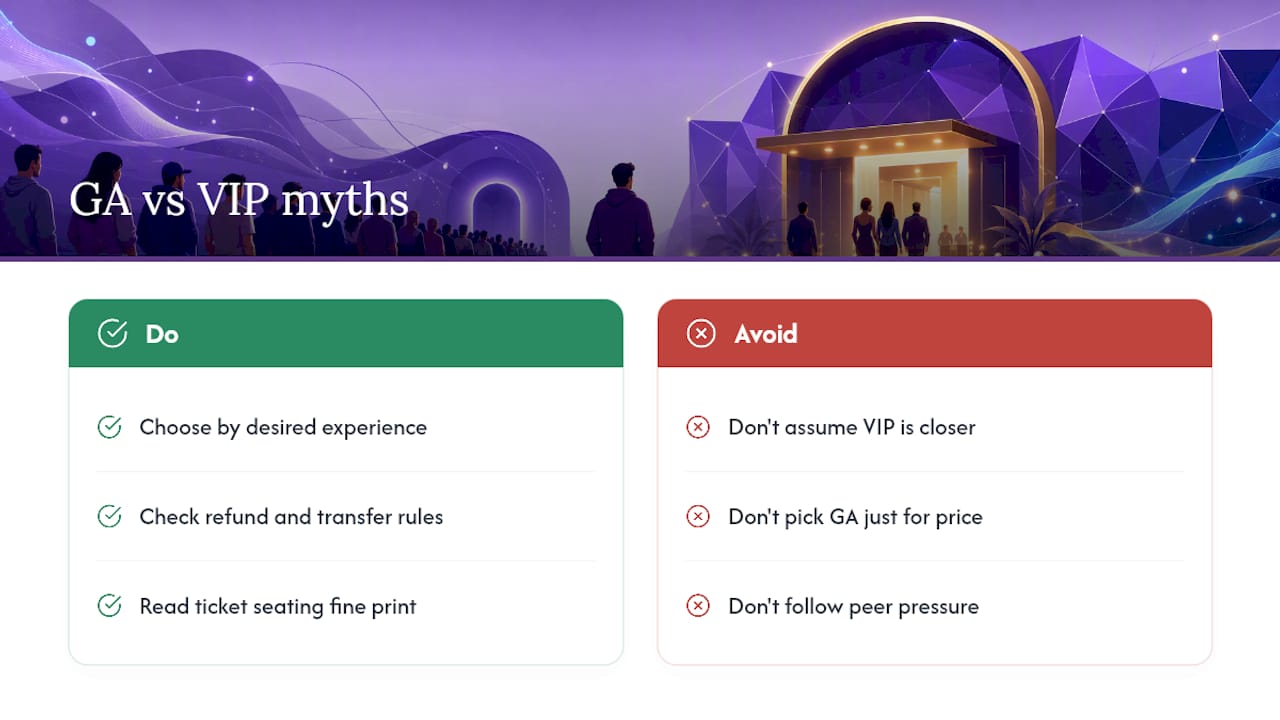
The most persistent myth is that VIP guarantees you’ll be closer to the stage. Sometimes it does. Often it just means a separate, calmer section that’s no closer, or occasionally farther back, than a well-timed GA spot near the rail.
A second myth: GA is only for people on a budget. Plenty of festival veterans deliberately choose GA even when they can afford VIP, because the pit energy and crowd connection are part of why they came. Price isn’t the only variable in that decision.
Third myth: VIP tickets are refundable or transferable more easily than GA. In reality, tier has little to do with refund policy. Refund and transfer rules are set by the promoter and platform, not by whether you bought GA or VIP, and both are usually equally restrictive once a show is confirmed.
Fourth, and maybe the most expensive misconception: that a printed seat number on a GA ticket means you have an assigned seat. As both Ticketmaster and StubHub note, that’s frequently just inventory tracking. Showing up late because you assume your “seat” is waiting for you is one of the more common GA regrets.
Finally, some assume VIP is always worth it at big-name festivals simply because everyone else is buying it. Peer pressure isn’t a value calculation. The math from the cost section above still applies regardless of how popular the upgrade is.
Which Events Actually Reward the Upgrade?
Event format changes the calculus more than any other factor.
Club shows and single-set concerts almost always favor GA. You’re there for two to three hours, the room is small enough that sightlines aren’t a real problem, and the premium rarely buys back enough comfort to matter.
Arena tours sit in the middle. VIP packages here often include early entry and merchandise bundles, which can be worth it if you’re a serious fan of that specific artist, but the comfort gain is smaller than at a sprawling outdoor event.
Multi-day festivals are where VIP earns its price most consistently. Ten-plus hours a day, brutal heat, long walks between stages, and packed public restrooms all make lounges, shade structures, and shorter lines genuinely valuable rather than nice-to-have. The Business Insider look at Coachella’s VIP tier captured this well: the premium viewing and rest areas mattered most on the longest, hottest days, not the shorter evening sets.
Block parties and outdoor community events, the kind Slappers N Bangers is built around, tend to reward GA. The draw is the shared crowd energy and dancing together, not separation into private sections. A packed floor is part of the point.
Refunds, Transfers, and Resale Rules by Tier
Ticket tier and ticket policy are two separate systems, and conflating them causes most of the confusion at checkout.
Refund policies are almost always set at the event level, not the tier level. If a show gets canceled, both GA and VIP holders typically get the same refund treatment from the platform. If you simply change your mind, most platforms treat both tiers as final sale, regardless of price paid.
Transfers work similarly across tiers on most major platforms, though some VIP packages that bundle merchandise or meet-and-greet add-ons carry extra restrictions since those perks are often tied to a specific name for security or capacity reasons.
Resale is where things diverge more. VIP tickets, because they carry a higher face value, tend to attract more aggressive resale markup and more fraud attempts. Buyers should always verify they’re purchasing through an official platform or the event’s direct page rather than a third-party marketplace with no seller verification, a caution echoed across ticketing platforms’ own help documentation.
COVID-Era Changes That Stuck Around
Health and safety protocols reshaped how both GA and VIP experiences get delivered, and several changes never fully went away.
Capacity limits during the pandemic pushed many events toward more structured entry timing, staggered arrival windows that used to be a VIP-only perk started appearing for GA ticket holders too, spreading out crowd density at the gate. Some of that structure has stuck simply because it works better logistically.
VIP areas, already built around separation and smaller crowds, adapted faster to distancing requirements than packed GA floors did. That gave VIP an unplanned reputation boost as the “safer” option during the height of the pandemic, and some events still market extra space and reduced density as a VIP feature even though the acute health emergency has passed.
Cleaning protocols for shared restrooms and bars became a bigger selling point across both tiers, and separate, better-maintained VIP restroom facilities remain one of the more consistently delivered upgrades today. If health and comfort around crowd density is a real priority for you, that’s a legitimate factor to weigh into the VIP value calculation from the cost section above, not a leftover pandemic gimmick.
When We’d Splurge on VIP (and When We Wouldn’t)
For a single high-energy night out, we’d save the money and buy GA. For a long, hot, multi-day festival, or a show where the whole group is upgrading together, VIP earns its price more reliably. Either way, run the value-score math from the cost section before you commit. Don’t just buy the label.
— Slappersnbangers@gmail.com
Check Ticket Tiers for Upcoming Events
Every event page lays out exactly what each tier includes, so you’re never guessing whether “VIP” means a real perk or just a higher price tag. Reading the specifics before you buy is the whole point of the value method above, and events are built to make that comparison straightforward rather than buried in fine print.

If you’re weighing GA against VIP for an upcoming show, start with the current event lineup and ticket tiers to see what’s actually bundled at each price point. Heading to the Brooklyn, Queens, and Newark summer event this season? Check the tier breakdown before you buy, since knowing what’s included in advance is the fastest way to avoid overpaying for perks you won’t use, or underpaying for ones you actually want.
Sources
- What is General Admission, unreserved seating/standing, or Standing Room Only? – Ticketmaster Help
- Festival
FAQ
What Is the Difference Between VIP and GA Tickets?
GA gives you unreserved standing or seating claimed on a first-come basis, while VIP bundles perks like early entry, reserved viewing, lounges, and sometimes food or merchandise credits for a premium price.
What Is the Difference Between GA and VIP?
GA is defined by access without a guaranteed spot, and VIP is defined by whatever specific comfort and convenience perks the promoter chooses to bundle, so the details vary event to event.
Is VIP Really Worth It?
It depends on the math: VIP is worth it when its included perks (parking, credits, lounge access) plus comfort value exceed the extra cost, which tends to happen most at long, hot, multi-day festivals rather than short single-set shows.
What’s the Difference Between VIP and General Admission?
VIP trades crowd energy and lower cost for guaranteed comfort and convenience, while general admission trades some predictability for a cheaper ticket and a spot in the thick of the crowd.
Does a Higher Price Always Mean Better Viewing in VIP?
Not necessarily. Some VIP sections sit farther from the stage than a well-timed GA spot near the rail, so it’s worth checking the venue’s specific viewing description rather than assuming price equals proximity.